 Krater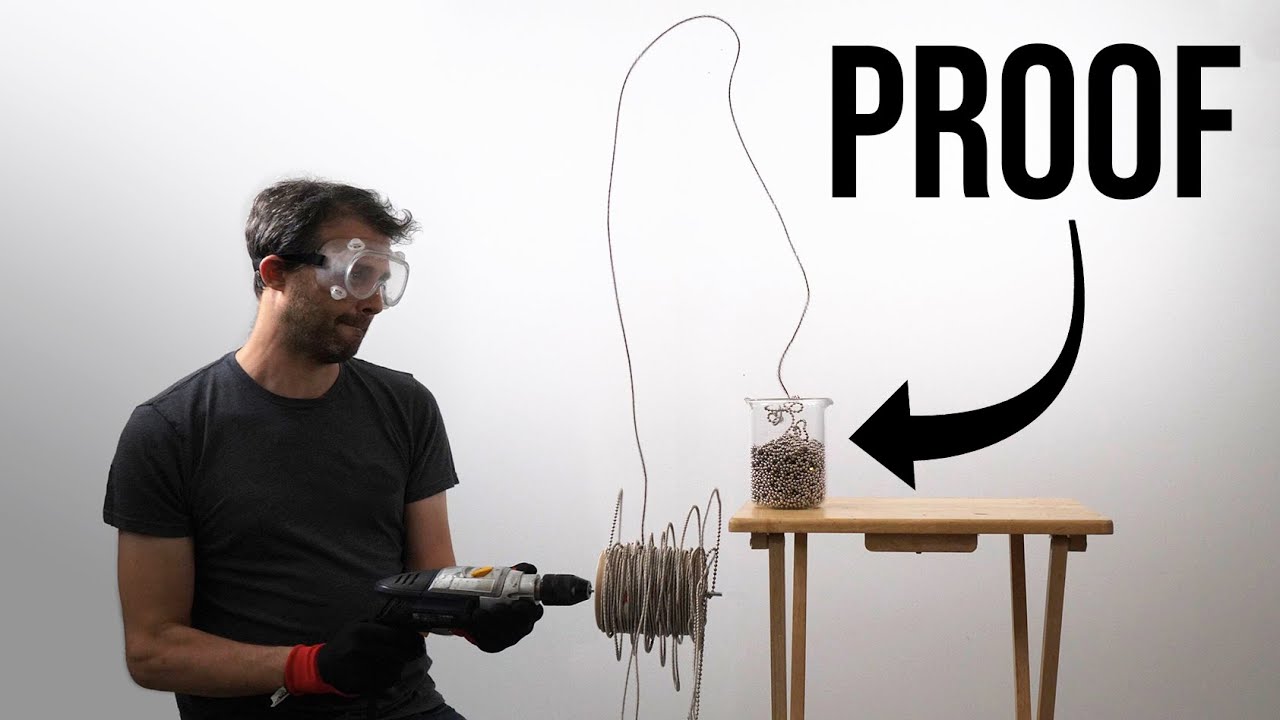
This Drill Powered Spool Proves Me Right
A video on YouTube. In Science & Engineering, a Krater category.
Watch on YouTubeSummary by Krater
Steve Mould investigates the physics of the chain fountain phenomenon, testing hypotheses about kickback forces from the container and chain stiffness using real-world experiments and simulations.
From the video
Answers: How does the chain fountain work and what causes the chain to rise above the container?
- Chain fountain physics
- Mould effect
- Rigid body simulation of chains
- Chain stiffness and bending
What it concludes
- A chain flows through the shape given to it, and that shape is maintained in the absence of gravity.
- A chain can rise up against gravity and hold there because of an additional kickback force from the pot.
- Even if the chain increases in speed over the course of the test, the fountain imparted manually at the beginning will still decrease over the course of the test due to gravity.
- Simulations show that chain stiffness leads to a levering effect, modelling the chain as a series of rods joined by flexible links.
- When a chain is under tension and you try and curve it, the maximum curvature is much lower, meaning the smallest loop size is much higher.
Rate it, review it and add it to your lists in Krater.
Titles and thumbnails from YouTube. Krater isn't affiliated with, endorsed by or sponsored by YouTube or Google.