 Krater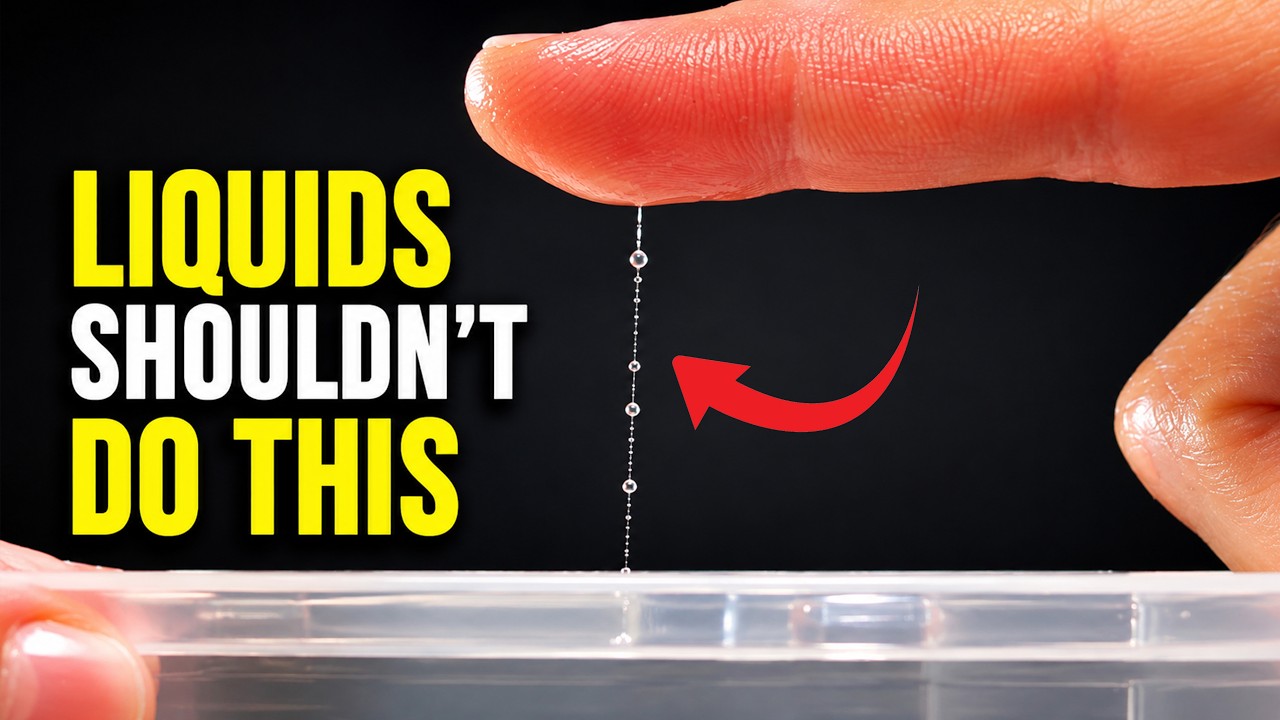
The Weird Connection Between Saliva and Quantum Physics
A video on YouTube. In Science & Engineering, a Krater category.
Watch on YouTubeSummary by Krater
This video explains the physics of how liquid streams break up into droplets via Rayleigh-Plateau instability, exploring how surface tension and internal molecular forces interact in water, saliva, polyethylene glycol, spider web glue, and Bose-Einstein condensates.
From the video
Answers: Why do liquid streams break up into droplets?
- Rayleigh-Plateau instability
- surface tension in liquids
- viscoelastic polymers
- spider orb web glue physics
- quantum liquid filaments
What it concludes
- Liquids want to reduce their surface area to minimize surface tension at the air-liquid interface.
- Rayleigh-Plateau instability occurs when the ripple wavelength is equal to the cylinder circumference, causing liquid streams to spontaneously form droplets.
- Viscoelastic polymers like saliva, PEG, and spider glue have internal elastic forces that stretch out and resist rapid collapse, slowing down thinning into droplets.
- Spider orb-web glue uses Rayleigh-Plateau instability to turn silk-coating liquid cylinders into regularly spaced droplets without needing thousands of microscopic placements.
- Bose-Einstein condensates at near absolute zero can form quantum liquid filaments that undergo the same Rayleigh-Plateau instability as ordinary liquids.
Rate it, review it and add it to your lists in Krater.
Titles and thumbnails from YouTube. Krater isn't affiliated with, endorsed by or sponsored by YouTube or Google.