 Krater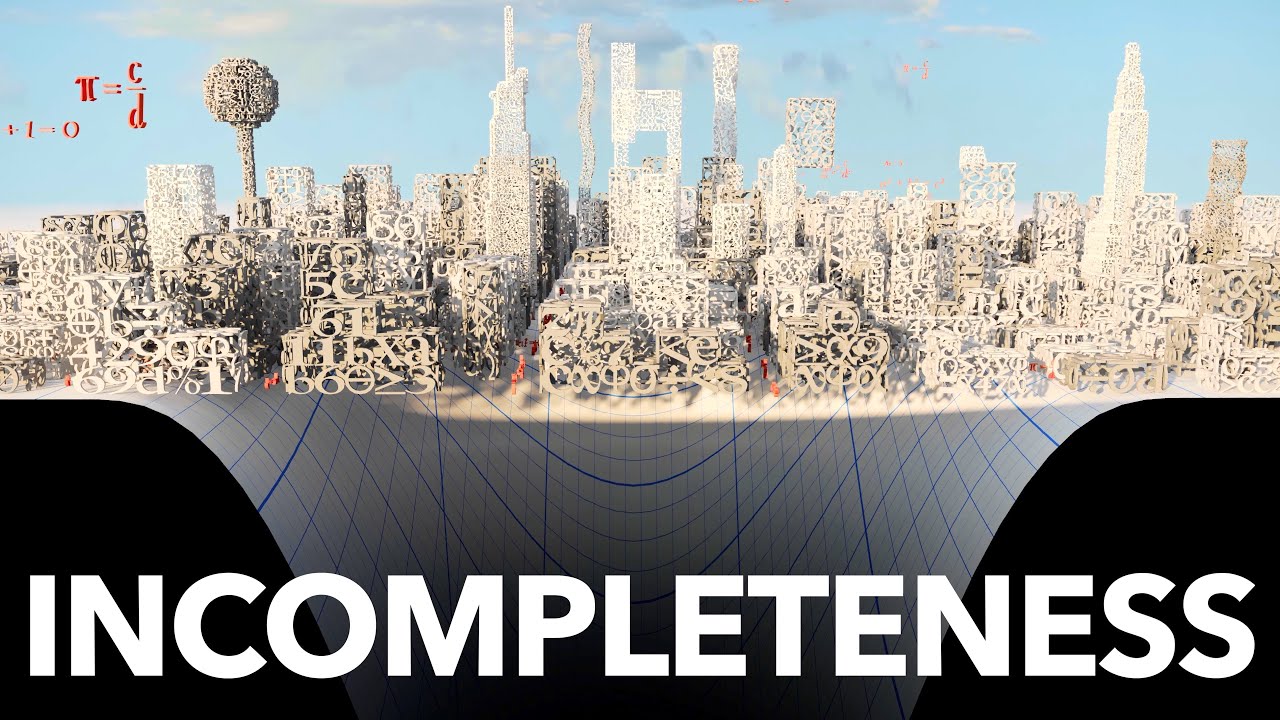
Math's Fundamental Flaw
A video on YouTube. In Science & Engineering, a Krater category.
Watch on YouTubeSummary by Krater
This video explores Kurt Gödel's incompleteness theorems, Cantor's proof of uncountability, and Alan Turing's halting problem, demonstrating that mathematics contains true statements that cannot be proven.
From the video
Answers: Why are there true statements in mathematics that cannot be proven?
- Gödel's incompleteness theorems
- Cantor's diagonal argument
- Turing machines and the halting problem
- Set theory and uncountability
- Formal systems of mathematical proof
What it concludes
- Cantor's diagonal proof shows there are uncountably infinite real numbers between 0 and 1, meaning not all infinities are the same size.
- Gödel's first incompleteness theorem proves that any consistent formal system capable of basic arithmetic contains true statements that have no proof.
- Gödel's second incompleteness theorem proves that any consistent formal system cannot prove its own consistency.
- Alan Turing proved the halting problem is undecidable, showing that no computer program can determine whether any arbitrary program will halt or run forever.
- The spectral gap problem in quantum physics was proven to be undecidable, meaning microscopic interactions are not always enough to deduce macroscopic properties.
Rate it, review it and add it to your lists in Krater.
Titles and thumbnails from YouTube. Krater isn't affiliated with, endorsed by or sponsored by YouTube or Google.