 Krater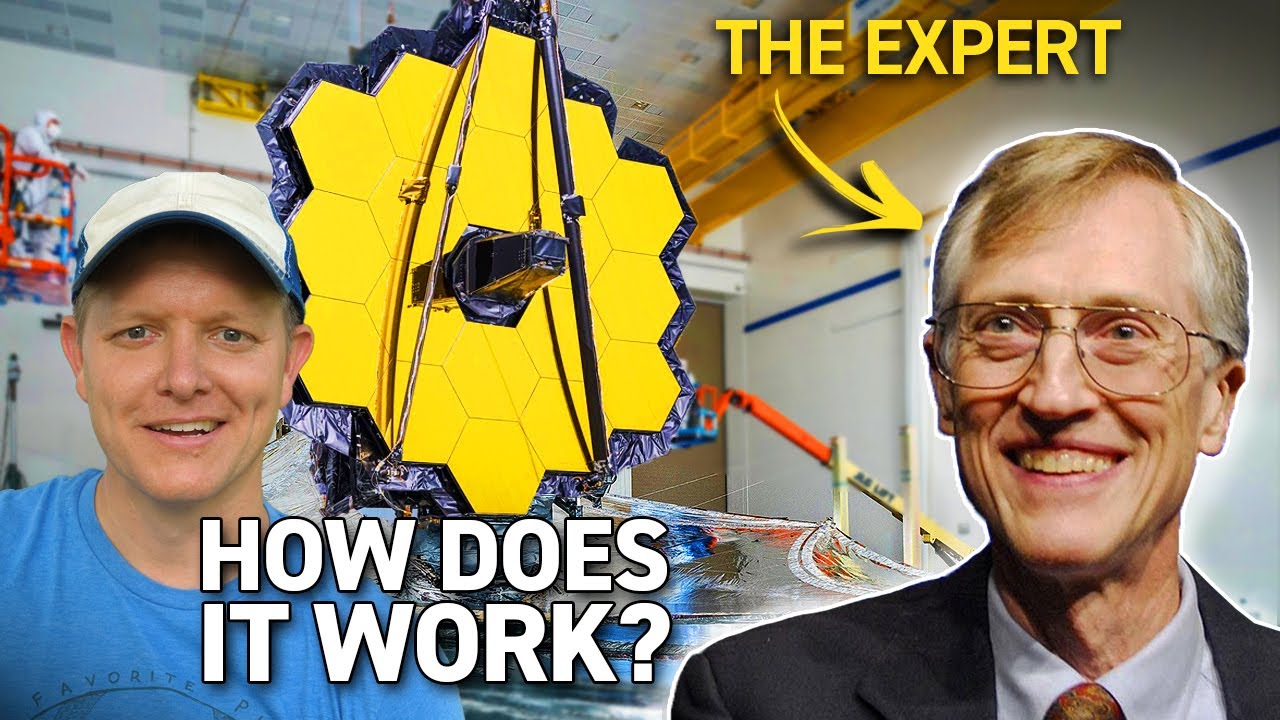
How Does The James Webb Space Telescope Work? - Smarter Every Day 262
A video on YouTube. In Science & Engineering, a Krater category.
Watch on YouTubeSummary by Krater
Smarter Every Day visits NASA Goddard Space Flight Center to discuss the James Webb Space Telescope with Senior Project Scientist Dr. John Mather, explaining its engineering, optical design, thermal management, and how it uses infrared astronomy and redshift to study the expanding universe.
From the video
Answers: How does the James Webb Space Telescope work and how was it tested?
- James Webb Space Telescope optics and mirrors
- Anamastigmat mirror configuration
- Thermal management and sunshield
- Lagrange points in orbital mechanics
- Redshift and infrared astronomy
- Vibration testing of space hardware
- Acoustic chamber testing
What it concludes
- The James Webb Space Telescope uses a three-mirror anastigmat design to capture light across a wide field of view using a large primary mirror made of 18 beryllium segments.
- The five-layer Kapton sunshield creates a permanent night-side for the telescope, keeping the optics at a stable 40 Kelvin without active cooling.
- Orbiting around the L2 Lagrange point allows the single-sided sunshield to continuously block thermal radiation from the Sun, Earth, and Moon simultaneously.
- Infrared astronomy and redshift analysis allow scientists to detect light from the earliest stars and galaxies whose wavelengths have been stretched by cosmic expansion.
- NASA subjects space hardware to extreme vibration and acoustic testing in large thermal vacuum and sound chambers to simulate rocket launch conditions on Earth.
Rate it, review it and add it to your lists in Krater.
Titles and thumbnails from YouTube. Krater isn't affiliated with, endorsed by or sponsored by YouTube or Google.