 Krater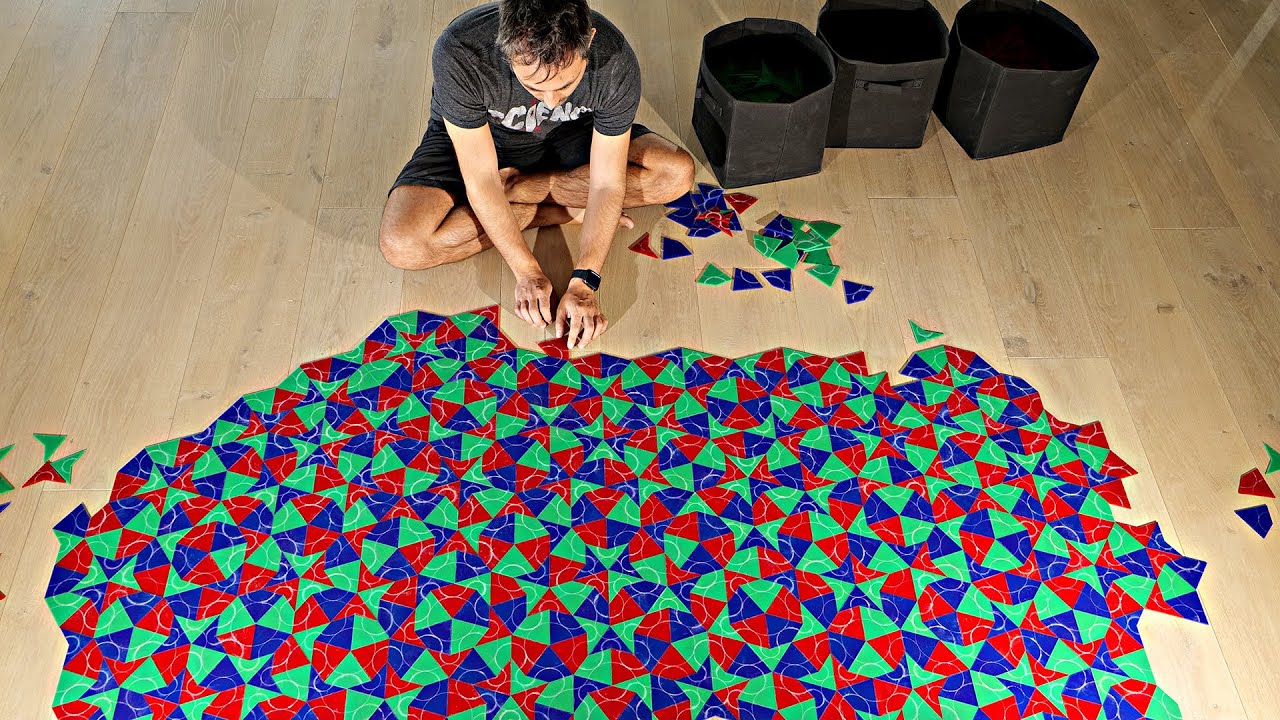
The Infinite Pattern That Never Repeats
A video on YouTube. In Science & Engineering, a Krater category.
Watch on YouTubeSummary by Krater
This video explores the history of aperiodic tilings, from Johannes Kepler's early 17th-century work to Robert Berger, Roger Penrose, and Dan Shechtman's discoveries in quasicrystals. It concludes that aperiodic tilings and quasicrystals demonstrate that order can exist in nature without periodic repetition.
From the video
Answers: How do aperiodic tilings and quasicrystals work?
- Platonic solids
- Johannes Kepler
- Kepler's conjecture
- Periodic and aperiodic tilings
- Wang's conjecture
- Kites and darts
- Golden ratio
- Fibonacci sequence
- Quasicrystals
- Crystallography
What it concludes
- Hexagonal Close-Packed and Face-Centered Cubic arrangements are equivalently and optimally efficient, occupying about 74% of the volume.
- Regular pentagons do not tile the plane.
- The only rotational symmetries a periodic tiling can have are 2, 3, 4, and 6-fold.
- Wang's conjecture was false because Robert Berger found a set of 20,426 tiles that can tile the plane only non-periodically.
- Roger Penrose reduced the number of tiles needed for aperiodic tiling down to just two: kites and darts.
- The ratio of kites to darts in a Penrose tiling approaches the golden ratio (1.618).
Rate it, review it and add it to your lists in Krater.
Titles and thumbnails from YouTube. Krater isn't affiliated with, endorsed by or sponsored by YouTube or Google.