 Krater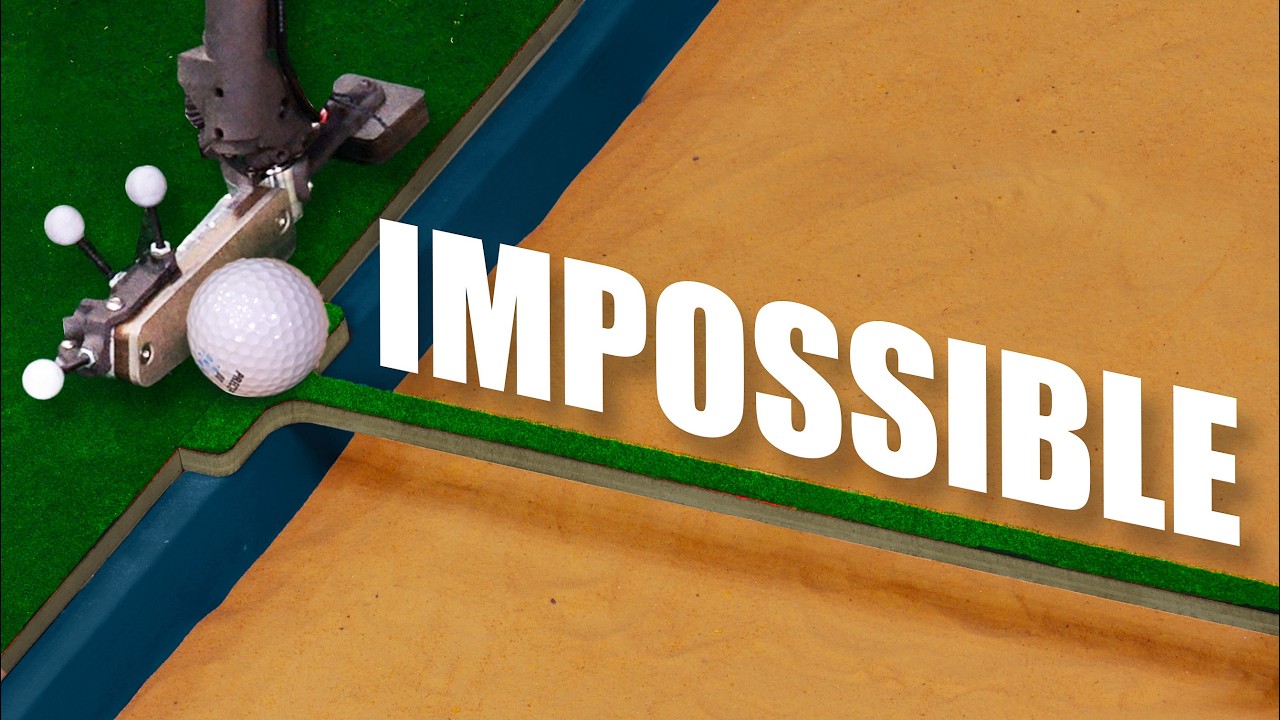
Robot golf vs holes that keep getting harder
A video on YouTube. In Science & Engineering, a Krater category.
Watch on YouTubeSummary by Krater
The creator programs a smart mini-golf club that uses motion capture and physics simulation to automatically aim at the hole, then tests it on challenging obstacles like bank shots, wavy hills, and a vertical loop.
From the video
Answers: How do you build a self-aiming mini-golf club using motion capture and physics simulation?
- Smart mini-golf club engineering
- Motion tracking camera setup
- Physics engine simulation
- Optimization algorithms for trajectory
- Thermal expansion compensation
What it concludes
- A golf ball bouncing off a wall is more complex than expected because its spin causes it to jump up and follow a curved path.
- Motion tracking cameras can be used as 3D scanners by recording the path of a reflective marker along a wall or inside a hole.
- A stochastic solver helps find correct physics parameters when exact trial and error takes too many combinations.
- Thermal expansion causes camera tripods and metal structures to shift position, requiring three reference markers on the course to automatically compensate.
- The physical mini-golf loop obstacle fails because ball bouncing off a wall introduces air drag and unpredictable speed changes.
Rate it, review it and add it to your lists in Krater.
Titles and thumbnails from YouTube. Krater isn't affiliated with, endorsed by or sponsored by YouTube or Google.